Showing posts sorted by relevance for query veil. Sort by date Show all posts

Monday, January 25, 2010

Working With Lace

It’s not uncommon for a Church Lady to have occasion to sew with lace. Veils are an obvious project; chapel veils, wedding veils, maybe a First Communion veil for your daughter or goddaughter. I’ve also used lace trim to lengthen a hemline or make a too-low neckline more modest, edge a prayer table cloth, trim an apron, and so on...

This chapel veil project will demonstrate some simple techniques you can use with a commonly found lace that is also inexpensive and easy to work with. Chantilly lace was originally a handmade bobbin lace from Chantilly, France. It’s typically a detailed floral design outlined by a somewhat thicker thread on an evenly knotted background. It was originally made of silk, but now you will probably only find nylon. These are two patterns of Chantilly lace you will find today at just about any fabric or craft store:
The nice thing about modern Chantilly lace is that it doesn’t ravel at all so you don’t have to finish the edges. That quality makes it really easy to work with.

For this project, you’ll need lace yard goods (sold on a bolt and somewhere between 36” and 72” wide) and lace trim.

And this is where it gets fun. Because this lace doesn’t ravel, you can cut it in all sorts of patterns. For example, I started with this piece of trim

and was able to use a small embroidery scissors (or cuticle scissors) to cut it into three different, usable designs.
I’m using the narrow border for this veil and tucking the other pieces away for a future project.

1. Design a pattern: A classic triangle-shaped veil is 36 inches across the front and 18 inches from the center front to the back point. The one I made here is more of a D shape. I started with a 22” x 18” rectangle of scrap fabric, folded it in half and rounded the corners.
At this point, try it on your head to get some idea if you like the length and shape. Now is the time to change it if you don’t like something.

2. Pin your pattern onto the lace. I purchased ½ yard of 54” wide Chantilly lace. That would be enough to make two veils in this design. (I’m only cutting one out now.) It’s a nice touch if you can consider the design in the lace when you lay out your pattern. For example, I was able to center the pattern on one of the flower motifs. (This detail is probably not a deal breaker, but does give a more professional look.)
3. Cut the lace around the pattern, unpin, and carefully tuck your pattern away for the day when some other Church Lady asks where you got your beautiful veil. ;-)

4. Pin your border lace in place. Again, consider the placement so the center front is as nice as possible. Place the ends in the most inconspicuous spot (mine are on the side, near the back) The goal for pinning is to avoid puckering when you sew! You’ll want to place your pins pretty close together so everything is held firmly in place.
You may not want to pin the entire perimeter (pins have a maddening tendency to fall out of lace), but keep at least the 6” in front of your needle pinned. When working on a fine fabric like this, I like to sit at a table so the entire piece of fabric is well supported. It helps keep the pins in place and makes things less likely to pucker as I sew. Really, it’s just a personal preference though. You could also sew with it resting on your lap.
5. Use a running stitch, following the trim design around the edges to hold all the points and flowers down. This lace is pretty narrow; If you’re using a wider one, you’d want to sew on both edges of the trim to hold the fabric down and make things look nicely on the back as well. My running stitches are small on the top (first photo below) of the veil and longer (about ¼ inch) on the back. (second photo below) knot your thread every few inches to make it all more durable.
You’ll soon get the feel for the proper tension for your stitches. The goal is a balance between slack thread and puckered stitches. If you’ve never done this before, you may want to do a few inches of practice stitches on some scrap lace.

6. When you get to the ends of the trim, overlap them slightly and stitch them in place.

In summary, make a pattern, cut out your lace, sew the trim on with a running stitch, wear your veil. Simple!

The entire veil only cost about $4
  • ½ yard lace - $3.90 (Originally $12.99/yard but I used a coupon. Seriously, I don't think I ever pay full price at JoAnn Fabrics. Sign up to get their coupons if you're near one of their stores. Remember, this was enough to make 2 veils, so the cost per veil was under $2.)
  • 2 1/3 yards trim (The trim I originally purchased cost $2.15. I ended up using a piece I had in my lace scrap box - the piece pictured here - because it was better for demonstration purposes.)
  • All-purpose thread
  • Needle
  • An embroidery scissors with a sharp tip
A few more notes:
  • It's easiest to use a narrow trim lace. Wider trims can be dramatic and beautiful, but it may require some creative cuts to make it stay flat around the corners.
  • I was really surprised to see how few choices my fabric store has for lace trim! Just a month ago they offered three times the trim they now have. I hope this trend doesn't continue.
  • Obviously, you can find lace in the bridal department, but you may also want to check the decorator department. I've seen some really pretty laces that are made for drapery or tablecloths. :-)

Monday, March 31, 2008

Veils and more

The Church Ladies have different takes on chapel veils. Some wear them always, others only at the Extraordinary Form, and some fall in between on the chapel veil spectrum. But we all agree that every Church Lady needs a veil for her wedding (and First Communions, for those Church Ladies in training). In fact, rumor has it a certain Church Lady was denied the opportunity to wear a veil at her First Communion, and will be seizing the day at her upcoming wedding...

Permit me to introduce Halo Works, and its founder, the delightful Maureen. From First Communions to Quinces to weddings and funerals, Maureen has veils for every occasion. There is even an easy wear category for the mantilla inept (like me, who ends up with a chapel bandanna by the end of Mass). Maureen's veils are beautifully made- some even come from Spain! If you don't see quite what you are looking for, Maureen will be happy to design a custom wedding veil (as she is for me). She searched tirelessly to find samples that would match my ivory dress. Halo Works also stocks other Catholic goods and gifts.

The wedding veil is more than an accessory; it has deep religious significance:
The next morning finds mother and daughter for the last time in their intimate closeness. Now I assist the bride to put on her bridal gown and to fasten the veil to her hair. Then she kneels down while the bridal wreath made of fresh white flowers is placed over the veil, at which time the solemn words are said "Receive here this symbol of your virginity which I have helped you to keep intact that you may give it unspotted to your husband as your greatest gift," to which the daughter answers with a heartfelt, "Thank you. Praised be God." This is always a moment of deep emotion. After the last long embrace I sign the forehead of my daughter with the sign of the Cross and then lead her downstairs, where the procession is already formed.

[Maria Trapp, Around the Year]

Also consider this wedding tradition:
Polish brides wear a wreath of flowers and herbs with their veil, which afterwards is saved in the hope chest. When virginity gives way to motherhood, the dried wreath is crumbled in the baby's bath, emphasizing the bond between marriage and family.
[Catholic and Loving It]

Tuesday, January 26, 2010

More veil ideas

There are lots of beautiful veils available (most with copyrighted photos so I won't use them here), but you can apply the principles from my post earlier this week to create many of them at home.

The foundation fabric most commonly used for veils is tulle, a fine netting typically made of silk or nylon. Nylon tulle is very inexpensive and comes in a variety of widths, up to 108 inches. Because it will not ravel when cut, it's perfect for this use.

This one starts with 72" or 108" width tulle. Cut a rectangle the length you want for your finished veil and then generously round the bottom. Hand sew the trim onto it according to yesterday's directions. To finish it, gather the top edge with a running stitch and sew it to a plastic comb (or two).

This one is a large oval of tulle with lace sewn around the perimeter. (Probably 72" width, but measure from one elbow, over your head to the other elbow for an accurate diameter.) It's worn just draped over her head, without a comb in photo 2. To wear it like photo 1, hand sew it to a plastic comb under the lace at the center top. To reinforce the lace, you could sew a piece of satin ribbon between the comb and the underside of the veil.

Instead of a lace edge, this one has a narrow, satin ribbon machine sewn about 1/2" from the edge of the tulle. After you attach the ribbon, trim the extra tulle edge away and attach it to a comb, headband, wreath, or hair clip.

This edge is finished with a narrow, satin rattail cord. Simply lay the cord on top of your tulle, about 1/2 inch from the cut edge, and use a zig-zag stitch and clear nylon thread or matching cotton/poly or rayon thread made for lightweight fabrics. Your stitch width should be wide enough that the zig-zag goes on either side of the cord, but not through it. Carefully cut the extra tulle off the edge without cutting through the stitching, and finish the veil with some kind of comb, etc.

This helpful site gives measurement suggestions, but there are also patterns with detailed instructions available.

Making a veil can be a very satisfying project. Besides the potential to save a lot of money, even a novice seamstress can get beautiful results.

Thursday, February 28, 2013

Notes from beneath the veil

Glad for distractions this week, I wanted to take a few minutes to post a link to Jen Fulwiler's Lenten experiment with wearing a veil.  Do go read it for yourself - her reasoning and reflection on the experience are both funny and beautiful (as always).

As a life-long seamstress, diy-er, and all-around cheapskate though, I have to admit that my first thought was "that veil would be so easy to make!"  The original came from this etsy shop, and at only $35 is a great deal, but if you'd like one right away for whatever reason, I have some suggestions here.

First of all, if you'd like the same concept, but don't want lace, you can find a nice tutorial on sewing your own infinity scarf here.

If you do want to make one of lace, it's even easier.

  1. Go to your local fabric store and find a soft lace with one or two finished edges.  For this basic version, you fabric will be somewhere between 45 and 60 inches wide.  (54" is also a common width.)
  2. Determine the length you want the scarf to be.  From the tutorials I'm finding, 54-60 inches seems to be a good length.  Since you'll be cutting along the length of the fabric, this is the amount you'll purchase.
  3. Cut the fabric in half lengthwise.  You'll have two pieces, each with one finished scalloped edge and one cut edge.  If you prefer, the pictorial directions at the bottom may be helpful.
  4. Sew the short edges together by hand or by machine.  Make the seam as neat as possible, since it will show (at least a little).  Again, owning a sewing machine is not necessary for this project!  You can find tips for sewing with lace in this Church Lady post.
  5. You can hem the unfinished edge of your veil if you'd like, but since many laces don't ravel it may not be necessary.
  6. That's it!  Oh, one more thing - you may have noticed by now that you have enough here for two veils.  The second one is for a friend.  (Aren't you wonderful!)


Tuesday, January 6, 2009

The Veil-Along begins


The Ravelry group KnitCatholics' Veil-Along starts today. Join us as we knit or crochet chapel veils!

[image source]

Tuesday, November 3, 2009

Feeling needed

For the University's trip to Chicago yesterday for a solemn high requiem Mass, I decided to fill my bag with some potentially useful items (for myself and the group at large - roughly 80 people!). I sent 20 chapel veils with the campus ministry employee to hand out as needed, which left me with the following in my bag:

-1 black chapel veil (mine)
- 1 missal
-1 bag of cough drops (lots of colds going around)
- The Privilege of Being a Woman (Alice von Hildebrand): my current spare-time reading (hopefully a post will be forthcoming about this fantastic book)
- The Holy Mass (Dom Prosper Gueranger); the book was given to me over the summer, and I absolutely treasure it. It's a wonderful explanation, succinct but thorough, of the Tridentine Mass. Perfect for study or meditation during Mass itself (though the section on sequences wasn't quite long enough to get me through the Dies Irae last night).
- 1 in-progress scarf (worked on in the car, not in church)

After Mass, the gentlemen in my immediate company wanted to go mingle without their books, so I added to my collection 2 more missals and a Breviary. And no, lest you ask, my bag isn't really that big. It was quite bulging with leather-bound books and I attracted lots of funny looks as I walked through the church. I wish I had taken a picture of it, but you'll notice that a camera was not on my list because my purse-sized camera was forgotten at home last time I was there.

Friday, March 19, 2010

The Way of the Cross


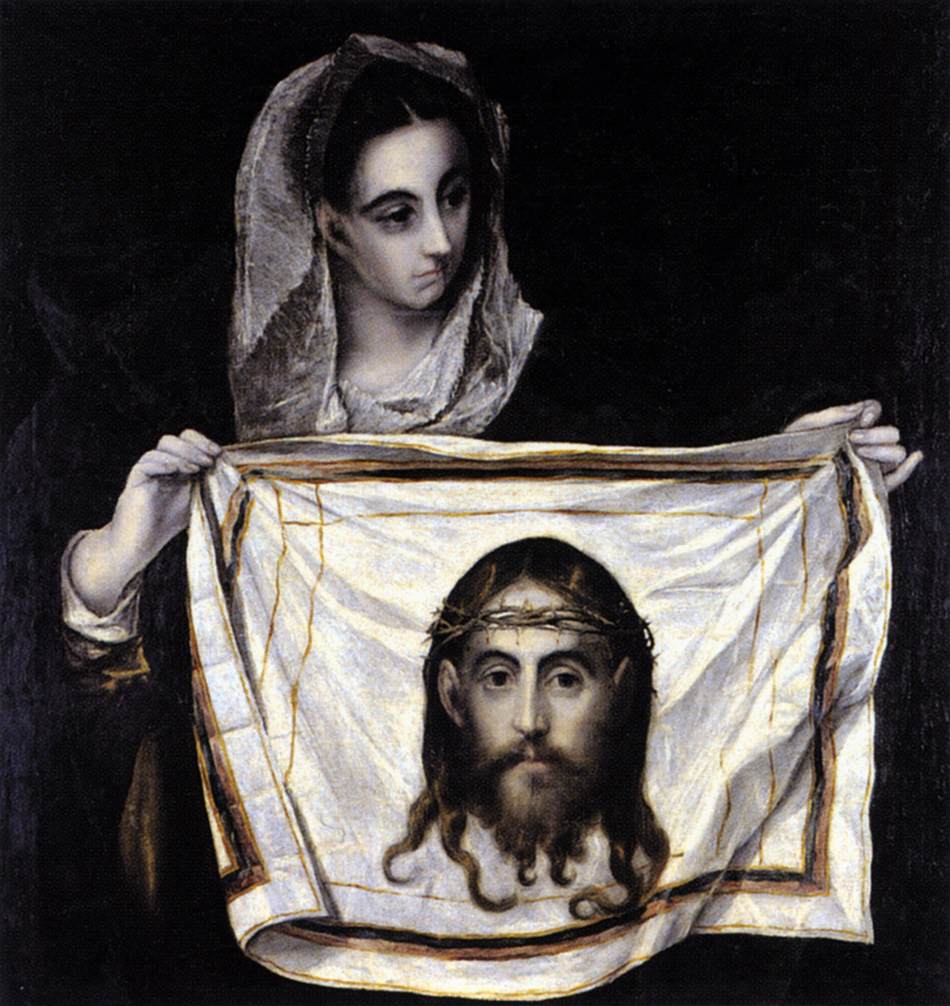
For today's prayer, the Church Ladies suggest these Stations of the Cross
with meditations from EWTN's Mother Angelica.

Image Credit: St. Veronica Holding the Veil by El Greco

Thursday, May 22, 2008

Social Justice in Action

One of my favorite annual events happens this week. Holy Family Catholic Adoption Agency is holding it's summer fund raiser garage sale. The charity itself is a worthy one as their mission is to work in practical ways toward an end to abortion. All prospective adoptive parents commit to a weekly hour of prayer before the Blessed Sacrament and/or a weekly "prayerful presence outside area abortion centers." In their few years of existence eight babies have been saved from abortions and placed in loving Catholic homes.

Now on to this fund raising event ... This garage sale, held in two large buildings at the county fairground, takes donations from people all over the area. Typically, tables are piled high with a wide variety of clothing, household and garage items, sporting equipment, furniture - typical garage sale stuff. The beauty here is that instead of throwing items away, all of these people have saved them donate to this event. I know in our house, we always have a box (or several) in our garage, ready to receive the things for which we no longer have a use. A group of volunteers of all ages come on drop-off day to sort items. On the sale days there are long lines waiting for the doors to open. And this is the third part I love about this event - nothing is priced; they just ask patrons to consider what they can afford and what the items are worth, and then to pay a donation based on that.

The entire system exemplifies social justice principles at their best. We are provided with a practical way of being good stewards, lives are being saved, prayer is encouraged, people who can afford to give donate generously, and those who can't afford much are still provided with the clothing and other goods they need.

Besides all that, we usually come home with some treasures. While it's not specifically a Catholic event, there are lots of Catholic donors and it's not unusual to find spiritual classics, kitchsy statues, copies of bad liturgical music, Bibles, etc. This year I found several books, a beaded purse, four lovely (maybe silk) scarves, some vintage jewelry, a chapel veil, and this very classy piece which is now in a place of honor on my teacup shelf.

Wednesday, November 4, 2009

Mantilla the Hon

Famous ecclesiastical fashionista, Mantilla Amontillado (Father Longenecker's guest blogger, and one of his alter egos) uses her impeccable taste in all things ecclesial and her degree in Ecclesiastical Haberdashery from Salamanca University to comment on a wide variety of topics of interest to Church Ladies. Her basic philosophy is as follows:
I say, if you're going to be a Catholic look and sound like a Catholic. Throw out the polyester. Bring in polyphony. Those cheap see through cassock albs are surplus. Bring back the cassock and the surplice. Throw out the people of the parish parade. Bring in the procession with lots of brocade. Men should know their place: it's wearing lots of lace. Forget the reform of the reform. We're talking revolution of the reform.

Mantilla on Beauty and Truth: "Now I'm realizing that when I see that polyester chasuble with felt grapes on it, it's okay to be a little bit angry. When I see a church that looks like a cross between a slaughterhouse and a dunce cap and feel angry, that's okay, because ugliness is next to Godlessness. But when I see this nice brocade vestment or this antependium made out of this nice tapestry or I see a gothic chasuble in dark purple silk, or an altar boy wearing a lace cotta or a nun praying in a full habit it is okay for me to be happy because beauty is truth and truth beauty and this is all you need to know..."

Mantilla on Altar Dressings: "And what if you are going to visit someone important or maybe go to a wedding? Do you wear flip flops and a T-shirt? No you do not. You dress up you know? Well, it is the same thing with what you do with the chalice on the altar. You should make it beautiful, after all, you know the Mass is a kind of wedding banquet. It's the marriage supper of the Lamb. So you put the purificator over the chalice, and then the paten on top with the priest's host, and then the veil on top of that and then the burse with the corporal inside."

Mantilla Goes to Mass: "I go to this mass not long ago at another parish, and no, I'm not going to tell you which one, but Fr. Elvis comes in and he's got this kind of a game show approach to the liturgy. You know? I thought he was going to say, "Mantilla, today is your lucky day! Come on down and let's make a deal!" But he didn't he sort of saunters in and says, "Howya all doin' today? Anybody from Cincinnati? How are the Red Sox doin'? I heard this story once about this girl who wore red socks...The Lord be with you." You know what I mean? Well, I'm sitting there and my fan is going faster and faster, and it's not because of the flies I can tell you."

Mantilla on Clergy Hats: "I tell you someting. Listen. Whenever I see a priest in a hat it gives me what do you call it? Goose bumples. I get this shiver go right down my back and for the longest time I don't know why. Any other priest comes marching into mass and I maybe just yawn and flick my fan out and chase away a fly. Then we get this new priest in the parish and he's wearing the biretta. Wow! I give my friend Salsarita an elbow in the ribs, "Salsa, will you look at that new priest! He's wearing a biretta!" I haven't seen one these in years and it makes me think about priests in hats. I like it when a priest wears a hat, and maybe, you know, this is one of the nice things about being Catholic, that the priests put on headgear."

As you may have guessed, she has many more opinions and all are worth reading. Visit the Standing On My Head blog to read them all, and Father Longenecker - more Mantilla, please!


Thursday, March 20, 2008


"[L]et us take our part in the Passover prescribed by the law, not in a literal way, but according to the teaching of the Gospel; not in an imperfect way, but perfectly; not only for a time, but eternally. Let us regard as our home the heavenly Jerusalem, not the earthly one; the city glorified by angels, not the one laid waste by armies. We are not required to sacrifice young bulls or rams, beasts with horns and hoofs that are more dead than alive and devoid of feeling; but instead, let us join the choirs of angels in offering God upon his heavenly altar a sacrifice of praise. We must now pass through the first veil and approach the second, turning our eyes toward the Holy of Holies. I will say more: we must sacrifice ourselves to God, each day and in everything we do, accepting all that happens to us for the sake of the Word, imitating his passion by our sufferings, and honoring his blood by shedding our own. We must be ready to be crucified."

~St. Gregory of Nazianzen

Monday, March 8, 2010

What Not to Wear: When in Rome edition


Deciding what to wear to an evening wedding is challenging enough; imagine how daunting it is to choose proper attire for a papal audience.


Even the most seasoned president, prime minister and ambassador must struggle with deciphering proper protocol. But women, whether they are government leaders or the first lady, have to grapple with a lot more when they meet the pope.

The U.S. Embassy to the Holy See has a Vatican protocol primer that walks people through what is considered the proper dress code.

For men: black or dark suit, aka business attire, with a dark tie.

For women: black skirt or dress that reaches at least the knees, black top with mid- to long-sleeves, no pants, simple jewelry, dark closed-toe shoes, and a black hat or veil is optional.

A museum employee told CNS that dressing decently is a common courtesy; one is after all a guest in "a place deserving respect" when visiting the museums or a pilgrim in a place of worship when visiting the basilica.

Clothes do indeed make the woman and the man, and they can also make or break a visit to the Vatican.

[full Catholic News Service article]
[image source]

Wednesday, December 2, 2009

Thrifty Gifts: Emergency Car Kit

The grandfather of Rosaleen (one of the original Church Ladies, who has taken the veil) gives his grand-children one of these car kits the first winter they had a new car.

Put the following items in a box to be stored in the trunk.

-Shovel
-milk jugs filled with sand (or a jug of ice melts)
-Flashlight with batteries
-Blanket
-Bottled water
-first aid kit
-canned food (preferably with pull tabs)
-road flares and emergency matches
-duct tape

Tuesday, August 31, 2010

Today's Word

Of course, after mentioning it yesterday, the next logical word is

Novitiate (no-VIH-shee-eht)
A period of training and discernment for one seeking admission to a religious order. Like a postulant, Novices have not yet taken vows and are free to leave at any time. This is also a period of discernment for the order, and the Superior (leader) is also free to dismiss a novice if the arrangement is not discerned to be a good mutual fit.

From the ever-helpful Wikipedia:
After initial contact with the community, and usually a period of time as a postulant (a more or less formal period of candidacy for the novitiate), the person will be received as a novice in a ceremony that most often involves being clothed with the religious habit (traditional garb) of the particular religious community. The novice's habit is often slightly different from those of professed members of the order. For instance, in communities of women that wear a dark veil over the head, novices often wear a white one; among Franciscan communities of men, novices wear an additional shirt-like chest piece over the traditional Franciscan robe; Carthusian novices wear a dark cloak over the usual white habit; etc.
Novices are not admitted to vows until they have successfully completed the prescribed period of training and proving, called the novitiate. This usually lasts one year, the minimum required by Canon Law, though in some orders and communities it is two. Novices typically have dormitories in separate areas within a monastery or community and are under the direct supervision of a novice master or novice mistress.
Even more helpful is this page on the stages of formation of religious life from the Dominican Sisters of Mary, Mother of the Eucharist. The above photo is also from their site showing a postulant, a novice and a fully-professed sister.

The place where novices live is also know as a novitiate.


Sunday, March 9, 2008

Faith of our fathers

The uber-parish had a display of some of its antique vestments (all of which are in circulation) during the coffee social today.
White humeral veil

Altar cloth

Detail of gold fiddleback

Another detail of the gold fiddleback

Red cope

Violet cope
(My apologies for the photo quality- the 12 cups of Esther's Coffee had kicked in)

A big thanks to the uber-parish sacristan for his enthusiasm

Wednesday, May 13, 2009

The Art of the Wedding Shower

Wedding season is fast approaching! The Church Ladies' friend Seraphic walked down the aisle last weekend, and she'll be in good company before the summer's over.

There is an art to throwing a classy wedding shower in today's terribly tacky world. The Church Ladies provide some guidance.

-There can be nice showers at restaurants. But what better place is there to celebrate the beginning of a new "household of faith" than At Home? Your event will be more relaxed and personal.

-There is a time and a place for a co-ed party. It's called your wedding reception.

-Consider celebrating a culture of life and inviting girls and women in different seasons of their lives. (NB: This shuts down shenanigans like you wouldn't believe.)

-The ban on wearing a hat in your own home is lifted for wedding showers. Consider having a garland or veil on hand for the bride, depending on her taste.

-Light instrumental music sets the tone. Try some Saint-Saens or Elgar, available from your public library.

-This is the time for delightfully dainty food. Chicken salad on croissants, little cookies, and pink lemonade make for an elegant soiree that's easy on the cook. Who can easily be our friend Trader Joe if you're pressed for time.

-If the bride is without local relatives, ask her if she needs help with anything, like addressing invitations or packaging wedding favors.

-Sometimes wedding showers bring together women from different areas of the bride's life. Casual games can help people relax. A tray memory game can be fun: place wedding related items on a tray, give the guests a minute to look at, then cover the tray and test their powers of recall! From a more challenging activity, prepare a list of scripture verses pertaining to love and marriage, and see who can identify the most (an ecumenical party game, as the Protestants will do better). Or generate a list of saints connected to marriage and the family, such as Catherine, Gianna, Margaret, and Monica, and match them with their patronage.

-Thoughtful home-made gifts might include an apron, potholders, or a tea-cosy. Another favorite theme is "something old, something new, something borrowed, and something blue." A gift should fall in one of those categories, like an antique hankie, a new cake pan, or a blue chaplet. Another much appreciated gift could be a gathering of household essentials around a theme, like pantry basics, spices, stationery, or cleaning necessities.

-The bride will get enough advice. Have everyone bring a favorite recipe for her instead. A nice story about the recipe is sweet too, such as "this was my husband's favorite casserole in our newlywed days." Cooking disasters are always amusing as well.

-Save the bows in a bouquet for the wedding rehearsal. Or, if you have some artificial flowers and ribbon looking for a new home, have each person pick one, and write a poem with their well wishes tying into the flower's symbolism, and gather whole creation together on a paper plate.

Good Luck!